Seeing the finding, not just the verdict.
Elavris Lite is a multimodal model for chest X-rays. It replies in language and outlines, at pixel level, the region it suspects of tuberculosis.
Elavris, short for Early Lesion Analysis and Visual Radiology Inference System, is a medical imaging AI research effort focused on tuberculosis, beginning in India. We build models that read a chest radiograph, answer in language and mark the region behind each answer, and we evaluate them under rules fixed before the results are known. Our aim is practical radiological support that earns trust through evidence, never ahead of it.
Tuberculosis is curable, yet it remains the world's leading infectious killer from a single pathogen. In 2024, an estimated 10.7 million people fell ill and 1.23 million died, with India accounting for roughly one in four cases. Timely, consistent reading of chest radiographs is one of the practical bottlenecks, particularly where specialist capacity is limited.
Source: World Health Organization, Global Tuberculosis Report 2025.
Because Elavris Lite is efficient to fine-tune and adapt, it is designed to sit alongside existing reading workflows and to shorten the time needed to review each image. Whether it does so is a question for prospective evaluation with radiologists, which is why partnerships are central to our roadmap.
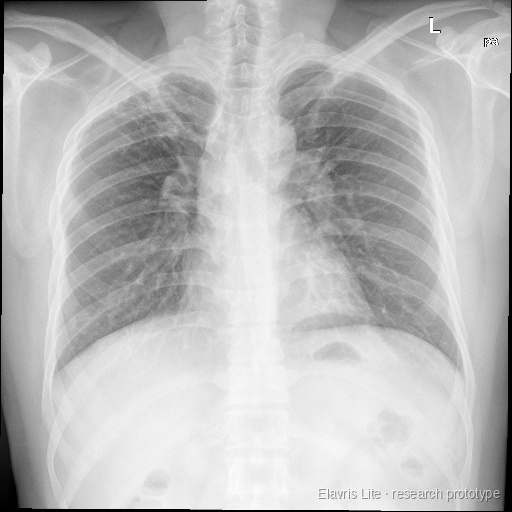
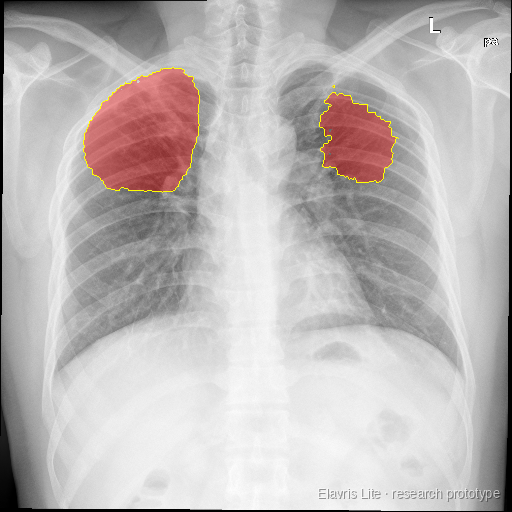
It answers in words.
Ask it about a chest X-ray and it replies in plain language.
I found tuberculosis involvement and outlined the affected regions.
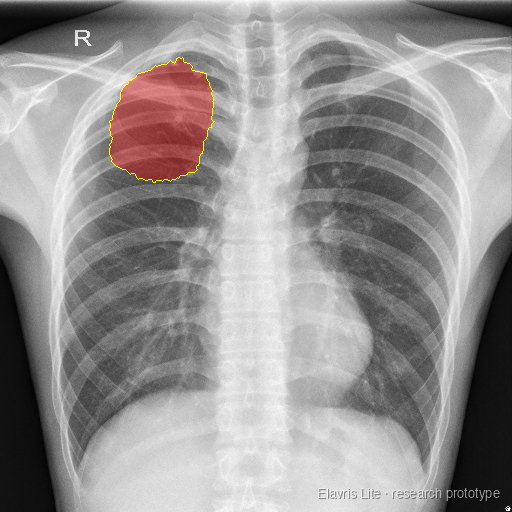
And it shows where.
A conventional classification model returns one verdict for the whole image. Elavris Lite also marks the region behind its answer, so the finding can be checked at a glance.
normal chest X-rays flagged
X-rays with a drawn tuberculosis area flagged
tuberculosis-labeled X-rays without a drawn area flagged
Version 1, small internal validation sets. Full results on the Evidence page.
Version 1 is the first step.
Toward better care.
Elavris Lite is a measurable path toward medical imaging AI that is designed to improve with each round of real-world data, beginning with tuberculosis.
Research prototype. Not a medical device. Not for diagnosis.